
Ski Accidents and Liability: When Is Another Skier Responsible?
4. December 2025When Is a Ski Resort Liable in the Event of a Ski Accident?
- Ski Accident and Liability of the Ski Resort
A ski accident can be not only painful, but can also raise complex questions of liability. Who is responsible when an accident occurs on the slopes? The general principles of liability after ski accidents are explained in a separate article. In this post, we focus specifically on the factors that determine when a ski resort may be liable for damages.
Duty to secure the slopes (piste safety obligations)
As a general rule, ski resorts are obliged to design, maintain and regularly monitor ski slopes and areas close to the pistes in a safe condition. This includes the removal of hazards or, where removal is not possible, adequate warnings through appropriate signage.
These safety obligations apply not only to ski slopes, but also to toboggan runs, access routes and parking areas. If a ski resort breaches any of these duties, it may become liable for damages.
Which hazards must a ski resort secure?
A ski resort is liable if it fails to secure so-called atypical hazards. Atypical hazards are obstacles that skiers cannot easily recognise, or that are difficult to avoid even if they are recognisable.
A hazard is considered atypical if, taking into account the appearance and announced difficulty level of the slope, it is unexpected or hard to avoid even for a responsible skier.
In summary, the decisive factor is the element of surprise. If skiers are unexpectedly confronted with a dangerous situation, an atypical hazard is likely present.
Examples of atypical hazards include:
-
curve sections of a ski slope followed by steeply falling terrain
-
ski slopes that run very close to cliffs, steep rock faces or similar terrain formations
-
snow lances and snow cannons
-
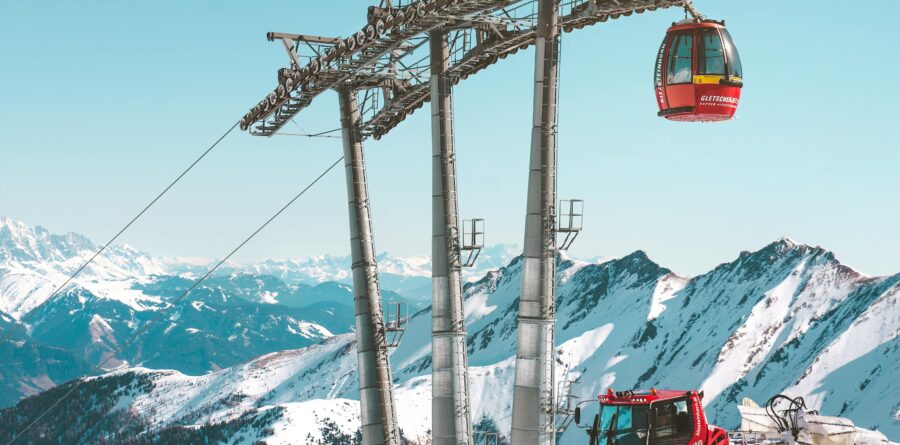
lift pylons
-
supports of safety nets or catch fences
-
large, unexpectedly occurring bare patches of ground
-
cables used for winch grooming with piste machines
-
rocks protruding into the slope area
-
concrete foundations or bases
-
very steep embankments sloping horizontally toward paths
A safety net at the edge of a slope must be installed so that its lower edge reaches the snow surface. If a fallen skier can slide underneath a raised net and suffer injuries on the steel anchors, the ski resort has breached its safety obligations.
A bare patch is considered an atypical hazard if skiers do not need to expect it — for example, where no other bare areas are visible anywhere else on the slope.
Typical hazards do not need to be secured
By contrast, typical hazards do not have to be specially secured. These include, for example:
-
a snow fence that is clearly visible and can be easily bypassed
-
a piste exit routed between two clearly visible groups of trees, leaving a free space of approx. 6.3 metres
-
a rock protruding next to a ski path that can be recognised from a distance of around 100 metres and can be safely passed even by a less experienced skier
-
a group of trees that is unobstructed and visible from more than 100 metres
Accidents during lift use
A ski resort may also be liable if an accident occurs while using a ski lift. The resort must ensure that skiers do not suffer injury when using lift facilities.
If a skier is injured during lift operation, liability of the ski resort is likely. This may be the case, for example, if:
-
a drag lift is not stopped immediately after a fall, or
-
the exit area is icy, causing a skier to fall.
In addition, accidents related to lift use benefit from the favourable burden of proof under Austrian strict liability law (EKHG). In such cases, the ski resort is liable unless the accident was caused by an unavoidable event. Fault is not required.
Accidents involving piste machines
If an accident occurs between a skier and a piste grooming machine or a snowmobile, liability of the ski resort is also likely.
During operating hours, piste machines may enter the ski area only in exceptional cases and must do so in a manner that does not endanger skiers.
Icy parking areas
The ski resort’s duty of care does not end on the mountain. Parking areas must also be kept safe and properly secured.
This means that the ski resort must, within reasonable limits, keep parking areas free of ice. At a minimum, the parking area must be gritted several times a day and regularly checked for icy surfaces.
If the ski resort fails to meet these obligations and a skier falls and is injured as a result, the resort may be liable for damages.
Burden of proof and liability advantages
If a ski resort may be liable, this has an important effect on the burden of proof. In such cases, the injured skier does not have to prove that the resort acted negligently. Instead, the ski resort must demonstrate that it did not breach its safety obligations.
This significantly facilitates the enforcement of claims.
The situation is even more favourable if the accident occurred in connection with the use of a ski lift. In these cases, it is not sufficient for the ski resort to show that it made no mistake. The resort must prove that it did everything correctly and that the accident was nevertheless unavoidable.
This distinction is crucial, as such proof is very difficult to provide in practice.
Finally, ski resorts are generally covered by liability insurance, which can compensate for damages. For this reason, claims against ski resorts are often promising where the facts support liability.
Conclusion
Whether a ski resort is liable after a ski accident depends on multiple factors and always on the specific circumstances of the individual case. However, favourable rules on the burden of proof — particularly in lift-related accidents — can substantially improve the chances of a successful claim.
Careful documentation of the accident and early legal advice are therefore essential. Skiers should be aware of their rights and take the necessary steps after an accident. We are happy to advise you and assess whether a claim against the ski resort is likely to succeed.

Haben Sie noch Fragen zu diesem Thema?
Kontaktieren Sie mich!
Mag. Pius Schneider+43 (0) 5552 62091
Termin online buchen